FIVE DAYS CHASING INDIGO
This was our first Simply Diligent retreat. The four of us, Ani, Aisling, Macy, and Virginia, travelled to a remote village in northern Vietnam to spend a week with a H’mong family who live and work with natural indigo. Their names are Nủ, Nhái, and their little daughter Mì. They welcomed us like family, opening their home, their kitchen, and their fields. We came to learn about indigo, but also to understand what life looks like when everything, from food to craft to care, comes from the same land.

Day 1: Arrival in Sapa
The drive up to Sapa was long and winding, but when the rice terraces finally appeared, it felt like entering another world. From there, we rode motorbikes down into Cat Cat Village with mist hanging low over the hills. That first night we unpacked, realizing we were sleeping with the mosquitos and the beetles, and pulled tarot cards, sharing what we each hoped to take away from the week.
Some of us had just met in person that same morning. Even so, we immediately felt comfortable sleeping on the floor next to each other, sharing face products, and chatting about our personal lives.
Day 2: First Indigo Lesson
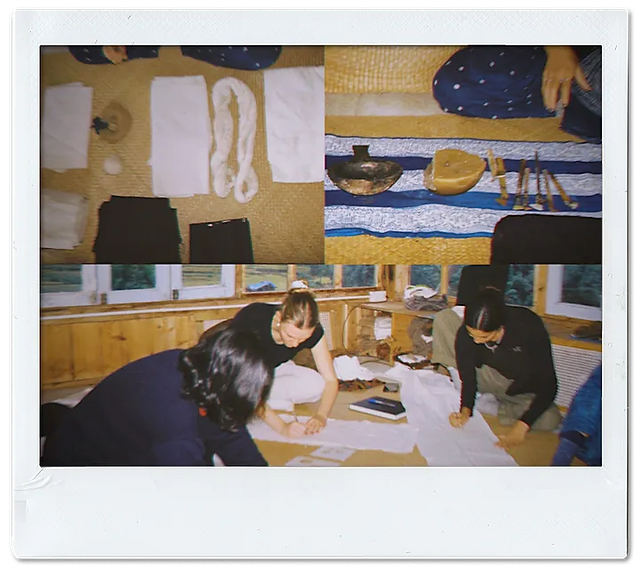
The next morning started with orange peel milk bread and strong tea. We spent the day in the family’s craft room, surrounded by handmade textiles and the faint scent of indigo, learning about the history and chemistry of this magical dye. Outside, it poured rain as we learned this slow sequence of steps, guided by hand and by feel, equal parts observation and patience. If you are curious about the chemistry quietly working beneath it all, we unpack it in more detail in a downloadable PDF here.
After helping with lunch, we harvested our first batch of leaves, filling the buckets on our backs after a slippery climb through rain and mud. We submerged the leaves in water in the vats to begin the indigotin extraction process, then walked into town and painted aquarelles as the light faded over the mountains.
Watching them harvest indigo once a year and maintain dye vats for years at a time showed how patience and care can create true sustainability. Using the most sustainable methods takes time and when the choice of quicker and faster methods exist, it’s an intentional choice to take the sustainable route. - AG
Indigo was at the centre of everything. It was not treated as a material to use, but as something living. The vats were stirred with care, checked every few hours, and kept balanced through both intuition and chemistry. They had two vats when we arrived, one that was a year old and the other two.
To create the dye, fresh leaves are soaked in water until they ferment. Ash water is added to raise the pH, allowing the indigo molecules to separate from the plant and settle at the bottom. What looks like a dull green liquid slowly transforms into the deep blue we all know, but the color only appears when the cloth touches air. The oxidation process is what makes the blue bloom.
Even though the dyeing involved scientific precision, it was clear that chemistry is something nature already does on its own every moment of the day. The process reminded me that nature already holds the perfect balance we often try to recreate, and when we work with it rather than control it, we often find results that feel more alive. And we feel more alive. - AW

Day 3: Water, Ash, and Balance
The following day was ash water day. We learned about alkaline environments and how simple materials like water, ash, and rice wine create what microorganisms need to thrive. As the rain kept falling loudly on the tin roof, we drew our designs on our fabrics and prepared the vats. In the afternoon, we wandered through the village and took in the stillness of mountain life, the mix of smoke, sound, and open air.
“It was by now that we all felt and understood that nature already holds the perfect balance we often try to recreate.” - AW
“Watching them harvest indigo once a year and maintain dye vats for years at a time showed how patience and care can create true sustainability.” - AG
Every step of the process asked us to slow down, to listen, and to trust that change would come in its own time.

Day 4: Wax, Blue, and Connection
The next morning, we waxed our patterns using beeswax from their hives. The wax creates a block that keeps parts of the fabric white while dyeing. Wax can be added between dips to create different shades. The designs waxed from the start stay white, while the ones waxed after a couple of dips remain light blue.
When the sun finally came out, we ventured into the rice fields and did a photography walk, then dipped our fabrics into the indigo vats. Watching the color appear out of nothing felt like witnessing a quiet kind of magic, one that exists entirely in the relationship between water, air, and time.
We ended the day with yoga back at the house, fried rice for dinner, and a writing exercise by candlelight.
Time moved differently in the mountains. Some days felt long, but the week passed quickly. We worked, ate, and rested together, sharing the kind of silence that feels full rather than empty. The pace was steady but never rushed, whether we were tending the dye vat or cooking dinner.
Every meal came from the garden or the nearby forest. Vegetables were picked just before cooking, rice steamed slowly, and tea leaves dried in the sun. As Aisling said, “A relationship is built on care and reciprocity. Everything we ate came straight from their garden or the surrounding land. Their connection to the environment isn’t separate; it’s woven into their daily lives.”
There was intention in everything Nủ and Nhái did. Nothing was wasted. It was fun, meditative, and brought us back into both our bodies and our minds. That felt true. Working with our hands again sharpened our focus and reminded us what meaningful work feels like.
Virginia described it clearly. “Consumerism was replaced by a practice of localism and collective creativity.” Cooking, cleaning, and learning beside them made it clear that connection is not an idea. It is something you build through participation and care.
“We’ve written about indigo and interviewed several people, but until I saw the process directly, I hadn’t realised how different it was from every other dye. My immediate thoughts wandered: how is it possible that this dye, which is so complicated, has become one of the world’s most used? However, after seeing the beauty of the colours, the shades, and the outcomes of different practices, it all makes sense. It’s the most beautiful natural dye I’ve ever seen.” - VR

Day 5: Rhythm, Reflection, and Rain
By day five, we had found our rhythm. Aisling and Ani double-dipped their pieces while Macy and Virginia re-waxed theirs. We made indigo paste, boiled our cloth to reveal the bees-waxed designs, and stood there in awe as our blue patterns appeared.
After lunch, we tried cyanotypes and then trekked into nearby villages. We ate squishy berries straight from a tree, walked past a wedding party with karaoke, and hid from a sudden downpour with a family who invited us in for beer until the rain stopped. The scooter ride home was chaos, soaked and laughing the whole way.
“We realised that we could have an incredible time without having access to a lot of the services that our respective cities offer. Time passed differently; people would walk hours to reach a rice patty on the other side of the mountain, or feed chickens across the valley. It might seem unnecessary for them to spend their limited time and energy on growing and processing indigo; however, it was beautiful that this was such a key priority. This might have been the most opposite process to the Fashion supply chain that we are used to” - VR
Day 6: Preservation and Progress
Our last morning began slowly with baked Brazilian cheese buns and tea. We did a little more shopping from the collection Nhai designs and hand-makes, collected our indigo paste, and took photos of our finished pieces. Soon after, we packed our bags onto the family’s scooter and made our way back through the village to the car waiting to take us to Hanoi.
Just outside the village, the sound of hammers and engines echoed through the hills. Hotels and new shops were rising fast, towering above the terraces. It was impossible not to see the contrast between the pace of the village and the rush of development.
“It was staggering to see the rapid development in Cat Cat Village and Sapa, new hotels rising beside the peaceful rice terraces.” - AG
The family spoke about this too, the balance between wanting to keep their traditions alive and wanting access to comfort and opportunity.
“People deserve the chance to modernize while still holding onto their heritage and knowledge.” AW
“I asked Nủ if he ever felt anxious about the future. He said people there don’t really experience anxiety the same way. His connection to the land gives him a strong sense of identity and purpose.” AG
Virginia called it one of the most extreme contrasts she had seen. “Luxurious hotels and restaurants next to a completely opposite way of living, where people shared everything.” It raised a question we keep returning to. What does progress really mean?
What we saw in Sapa is not new. Researchers trace a rapid tourism build-out that delivers income but also concentrates gains and accelerates cultural change. Heritage gets staged for visitors while everyday practices shift to fit the market. For textiles, that can mean Hmong batik and brocade entering fashion without clear benefit or authorship for makers. If progress is only measured in hotel keys and tourist numbers, we miss the point. The better question is whether people’s capabilities expand to choose comfort, to keep making what matters, and to decide their own future.
Macy reflected, “Belonging came with a new kind of responsibility, an urge to protect, to nurture, to do better even in the smallest ways.” Maybe progress is not about doing more, but about doing with intention.
A Way of Being
When it was time to say our final goodbyes, the week felt both full and fleeting. The quiet mornings, the smell of the dye vats, and the laughter around shared meals all stayed with us. Virginia noticed how deeply the family believed in indigo’s spirit, saying, “The belief that indigo held energy beyond being a dye, a power that shaped the way they saw and cared for the world.”

“Being in the mountains shifted my thinking around sustainability. It’s not just a set of actions but a reciprocal relationship cultivated with nature. It’s about being intentional in your approach to creating at every stage, even when more convenient options exist” - AG.
“Everything felt part of one living system, reminding us that the beauty of what we create is inseparable from the care we give to where it comes from” - AW.
These are the kinds of people and ways of making we want to see thrive. But it also reminded us of the limits of scale. Craft at this level of care cannot exist in mass production. It brings us back to what we talk about so often. Degrowth. The idea that progress might mean less, not more.
Beyond shared work, what was so precious were the shared stillness, shared experience, and shared breaths between mountains.
What we saw in Sapa was not a model to scale, but a way of being to learn from.
Thank you to Nủ, Nhái, and Mì for the best week ever. We miss you already.
Join us into our exploration of degrowth and how fashion can be a system of care as we continue on in 2026! And stay tuned for a chance to join us on our next Simply Diligent retreat 👀


Comments